
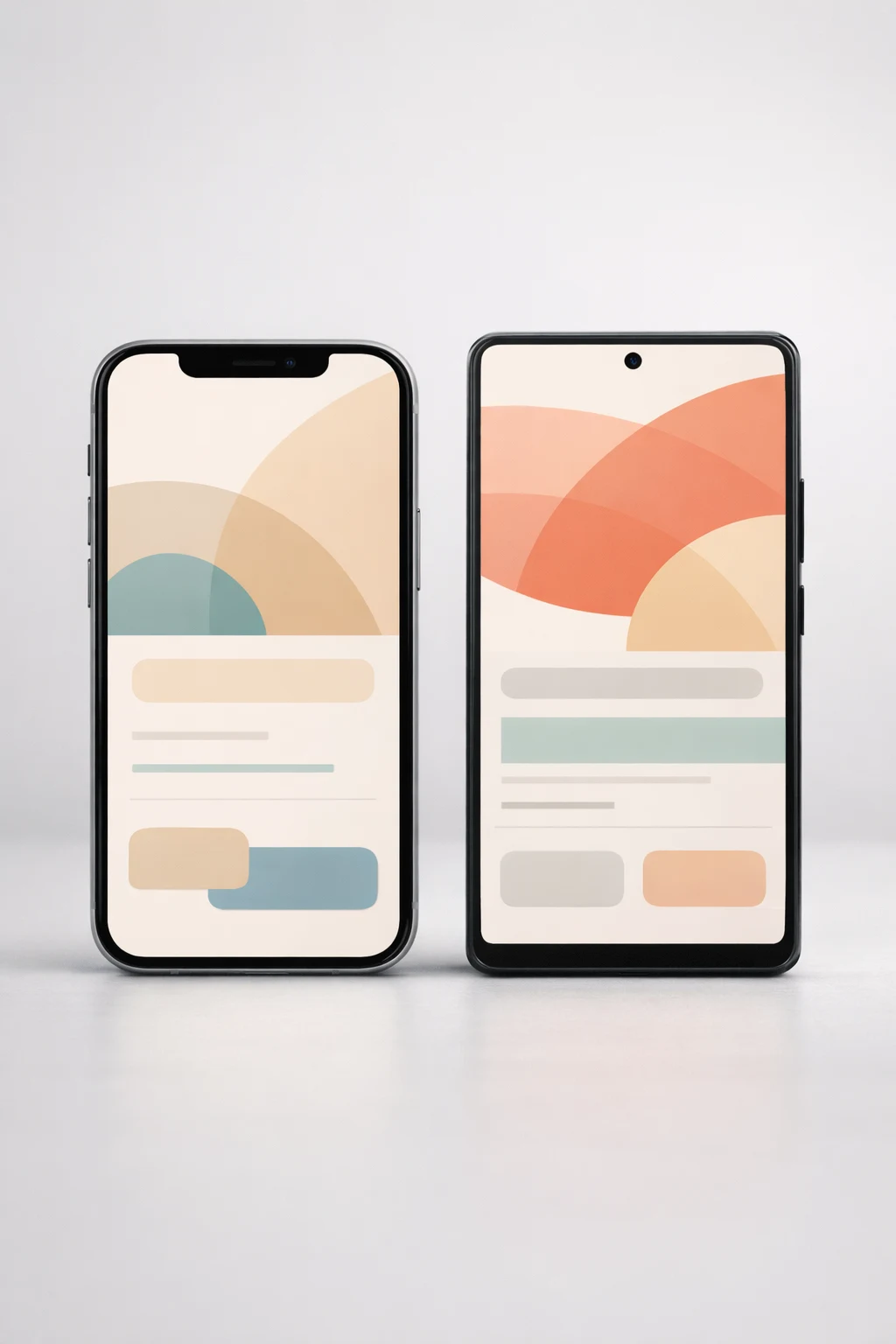
Choosing which platform to launch first is one of the earliest and most consequential decisions for a mobile product. The question "android vs ios app development" isn't purely technical — it combines market dynamics, user behavior, monetization strategy, engineering resources, and long-term roadmap considerations.
Start with the business goals, not the tech
Before you compare languages, SDKs, or device fragmentation, clarify the objectives your first release must achieve. Common goals include:
- Validating core product-market fit
- Testing a monetization model (ads, subscriptions, one-time purchases, in-app purchases)
- Proving user engagement or retention metrics
- Securing early enterprise customers or pilots
Your primary goal will often dictate which platform gives the fastest, most reliable signal. For example, if you need rapid revenue proof from consumer subscriptions, iOS users in some regions may convert at higher rates; if wide geographic reach and device diversity are critical, Android's global install base could be preferable.
Key market and user considerations
Audience geography
Android market share is dominant in many emerging markets, while iOS tends to have stronger presence in higher-income segments and certain developed markets. Map your target regions and customer profiles before choosing the first platform.
Demographics and behavior
Consider age, spending behavior, and device usage. Some verticals (e.g., premium productivity, creative tools) often see more revenue on iOS, while others (e.g., mass-market utilities or casual games) can scale quickly on Android.
Customer acquisition and retention
App store discovery mechanics differ. App Store editorial placement and search behave differently than Google Play. If you plan a big paid UA campaign, both platforms support it — but early retargeting, deep links, and attribution tooling can have platform-specific nuances.
Technical differences that affect timeline and cost
Native toolchains
iOS native apps are typically built with Swift (or Objective-C in legacy projects) using Xcode. Android apps use Kotlin (or Java) with Android Studio. Both platforms offer mature SDKs and rich tooling.
Development speed and learning curve
Developer availability and expertise in your region influence speed and cost. Kotlin and Swift are modern languages with concise syntax, but differences in platform paradigms (UI frameworks, background execution, permission models) create platform-specific implementation work.
Device fragmentation
Android has a much wider range of device manufacturers, screen sizes, OS versions, and hardware capabilities. This increases QA surface and can lengthen testing cycles. iOS has fewer device variants and more consistent OS adoption, which usually simplifies QA.
APIs and system features
Platform-specific features — e.g., iOS background modes, Android intents, platform-specific biometric APIs, or particular hardware integrations — may favor one platform depending on your product. Review required system-level features early to avoid surprises.
Design and UX considerations
Both platforms have human interface guidelines (Apple's HIG and Android's Material Design). Users expect native look-and-feel, so design adaptations are required:
- Navigation patterns: back button behavior differs; Android has a system back affordance.
- Controls and spacing: platform-specific UI components and touch targets vary.
- Animations and transitions: native patterns feel more polished to users.
Launching on one platform first lets you refine the core flows and interaction patterns before adapting them to the other OS.
Store submission, review, and release cadence
App Store review for iOS is known for stricter review guidelines and review times that can be variable. Google Play has automated reviews and generally faster publish times, though policies also evolve.
Consider update cadence and hotfix needs: Android’s phased rollouts and Google Play Console testing tracks are flexible, but iOS offers TestFlight for inviting beta testers with its own constraints.
Testing and quality assurance
Running a robust QA plan is essential. With Android's fragmentation you'll need a larger device matrix or rely on device farms. On iOS fewer devices still require testing across multiple OS versions and popular device models.
Automated testing frameworks exist for both (Espresso on Android, XCUITest on iOS), and cross-platform solutions (Appium, Detox) can help if you plan to reuse tests across platforms.
Cross-platform vs native—when to consider each
If your strategy is to launch simultaneously on both stores, cross-platform frameworks can reduce initial engineering effort:
- React Native and Flutter offer near-native performance and large ecosystems. Flutter compiles to native ARM code and often provides consistent UI across platforms; React Native bridges to native modules and works well for products that benefit from web-like development patterns.
- Frameworks can accelerate MVPs but may introduce trade-offs for complex native integrations, animation-heavy interfaces, or apps requiring cutting-edge platform APIs.
For a single-platform MVP, native development typically yields the best polish and access to platform-specific features.
Monetization and revenue mechanics
Store billing, refunds, and subscription handling differ. Apple's in-app purchase ecosystem is tightly controlled and has specific subscription tools and rules. Google Play offers more flexible purchase flows and alternative billing in some regions. Work with legal and finance teams to model how store fees, refunds, and geographies affect revenue forecasts.
Analytics, instrumentation, and backend
Instrument your app with analytics at launch so you can measure acquisition, retention, and funnel metrics irrespective of platform. Backend APIs should be platform-agnostic; ensure you design auth, push notifications, and telemetry to support multiple clients.
Decision framework: when to pick Android first, iOS first, or both
- Choose iOS first when:
- Your target users are concentrated in iOS-heavy markets or higher ARPU segments
- You need polished UI, consistent device behavior, and faster QA loops
- Your initial feature set relies on Apple's ecosystem features
- Choose Android first when:
- Your target audience is global or concentrated in emerging markets
- You need maximum install reach and device diversity
- Your app benefits from Android-specific platform integrations
- Choose both/pursue cross-platform when:
- You have resources to support dual development or a cross-platform stack
- Market expectations require presence on both stores simultaneously
- You want to validate product-market fit across different user segments within the same launch window
Practical roadmap for a first launch
- Define the MVP scope and success metrics.
- Map target geographies and user personas.
- Choose platform based on audience, required features, and team expertise.
- Decide native vs cross-platform based on performance and integration needs.
- Plan QA coverage and device testing strategy.
- Prepare store assets, privacy policy, and legal requirements for the chosen store.
- Instrument the app for analytics and set up monitoring for post-launch issues.
Checklist before you hit publish
- Privacy policy and data disclosures aligned to store requirements
- Crash reporting and analytics integrated
- Provisioning, certificates, and store accounts in place
- Beta testing completed across representative devices
- Marketing assets and store listings optimized for the chosen platform
Conclusion: weigh business goals over platform loyalties
There’s no universal answer to the "android vs ios app development" question. The right choice depends on your users, region, revenue model, engineering resources, and product differentiators. In many cases a single-platform MVP—treated as a learning experiment—produces faster insights and lower upfront cost. In other cases, market or enterprise requirements make a dual launch necessary from day one.
If you need help translating strategy into a realistic engineering plan, consider a phased approach that prioritizes your highest-value path forward. Learn more about how we help teams ship apps at scale on our services page. Ready to decide? Contact The App Wizards to review your product goals, evaluate technical trade-offs, and map a launch plan tailored to your business.